DETERMINISTIC
A reproducible numerical core.
Four accessible HealthKit values and three manual inputs enter a frozen, standardized Ridge model. An explicit run produces an experimental estimate and saves its source context.
EXPERIMENTAL NATIVE PROTOTYPE
A student reflection app connecting Apple Health and academic inputs with Ridge estimates, What-If scenarios and on-device conversation.

REAL APP · FICTIONAL DEMO DATA
THE QUESTION BEHIND THE PROJECT
Study records, assessment results and wearable summaries often sit in different places.
TwinTrack explores bringing that context into a focused reflection workflow. It is a digital-twin-inspired prototype: a shared model applied to recorded inputs, with clear boundaries around what its estimates mean.
THE REAL APP
Native SwiftUI. Current dark appearance.
Exactly three primary tabs.

01 / HOME
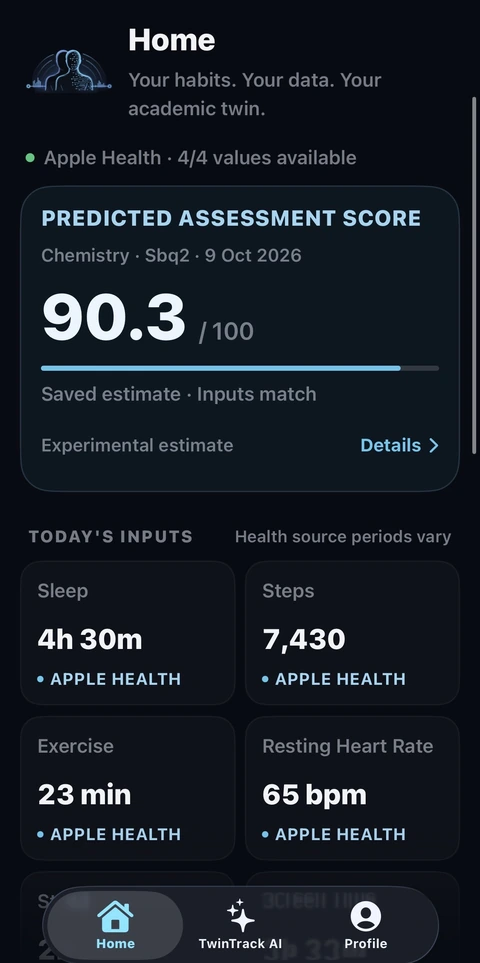
A saved estimate, the inputs behind it, and the next useful action. Refreshing the screen does not create a new prediction.
Genuine app captures. Fictional demo information. Tap a tab to inspect another space.
See how records are handledTHE WALKTHROUGH
Home, a real calculation, a temporary scenario, and an explanation of the saved result.
The final film will follow physical acceptance and UI freeze.
THE ENGINEERING IDEA
The numerical and conversational paths have different responsibilities.
DETERMINISTIC
Four accessible HealthKit values and three manual inputs enter a frozen, standardized Ridge model. An explicit run produces an experimental estimate and saves its source context.
GENERATIVE
App-owned routing and tools provide permitted context and numerical cards. Apple Foundation Models supplies conversation and explanation on supported, ready devices.
Subject, assessment and dates determine context and eligibility. They are not extra Ridge features. Missing or stale inputs prevent a new eligible calculation.
Synthetic-trained V2. Real-student predictive accuracy is not established.
Explore the full architectureMODEL SENSITIVITY
A different input profile.
The same frozen model.
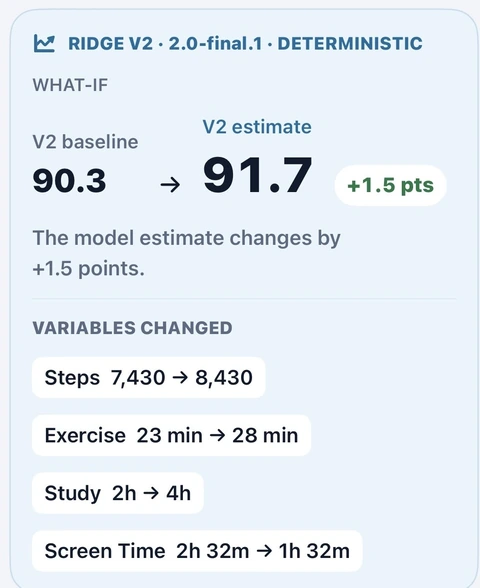
What-If starts from a captured eligible baseline, applies temporary changes and compares the outputs. It leaves real inputs and normal prediction history unchanged.
This shows how the model responds. It does not establish what changing a habit would cause.
Read the model contract
Light example: study changes from 2h to 4h. The Dark example uses 2h to 3h; these are different scenarios, not an appearance-only comparison.
WHAT CHANGED THE THINKING?
Wearable context was worth exploring. Its added predictive value had to be tested.
The completed NetHealth comparison found no convincing improvement beyond prior academic performance. The wider review also found unequal support across TwinTrack’s seven inputs.
The result sharpened the project’s purpose: an evidence-informed reflection prototype, with a research question still to test.
207 students · 963 repeated student-semester observations
A separate U.S. undergraduate study. It does not validate deployed TwinTrack V2.
Previous score has the strongest support. The other inputs have mixed, weak or insufficient direct academic evidence.
Inspect all seven inputsSOFTWARE VERIFICATION
Recorded 6 October 2026.
Complete simulator suite.
492 unit + 42 UI executions. Parity profiles are checked within unit methods, not added to the execution total.
Software verification establishes exercised behavior and numerical parity. It does not establish real-student prediction accuracy.
View scope, findings & evidenceRESPONSIBLE BY DESIGN
HealthKit reads are permission-controlled. Saved estimates and chats have separate controls. Export is user-initiated.
Inspect the data boundariesMissing readings are not fabricated as zero. Saved estimates remain historical when fresh inputs are unavailable.
Optional RHR trends and Body & Wellbeing information are non-diagnostic. BMI and body data do not become academic Ridge inputs.
Frozen V2 needs prospective comparison with a previous-score baseline. Calibrated real-student uncertainty is not yet available.
The next meaningful studyA GRADUATION PROJECT, BUILT THROUGH ITERATION
Applied Technology Schools — Baniyas
Grade 12 graduation project.
An experimental engineering prototype. Public app distribution and prospective predictive validation are not established.